

A service based business earns money by doing work for clients instead of selling physical products. That makes it one of the cheapest and fastest ways to start from home: you don’t need inventory, a storefront, or a big budget. You need a skill, a clear offer, and a way to find customers.
This guide explains what service based businesses are, how they compare with product businesses, and 10 ideas you can run from home. You’ll also learn how to price your services, find your first client, handle licenses and taxes, and grow beyond trading hours for dollars.
A note on numbers: this guide avoids income promises on purpose. Earnings depend on your skill, niche, pricing, and effort. Cost ranges are general estimates, not guarantees.
What Is a Service Based Business?
A service based business sells expertise, time, or labor rather than a physical item. The customer pays for a result, such as a finished website, a balanced set of books, or a tidy home.
Common examples include freelancing, consulting, coaching, tutoring, cleaning, bookkeeping, design, and pet care. Some work happens online, and some happens in person in your local area.
Service Business vs. Product Business
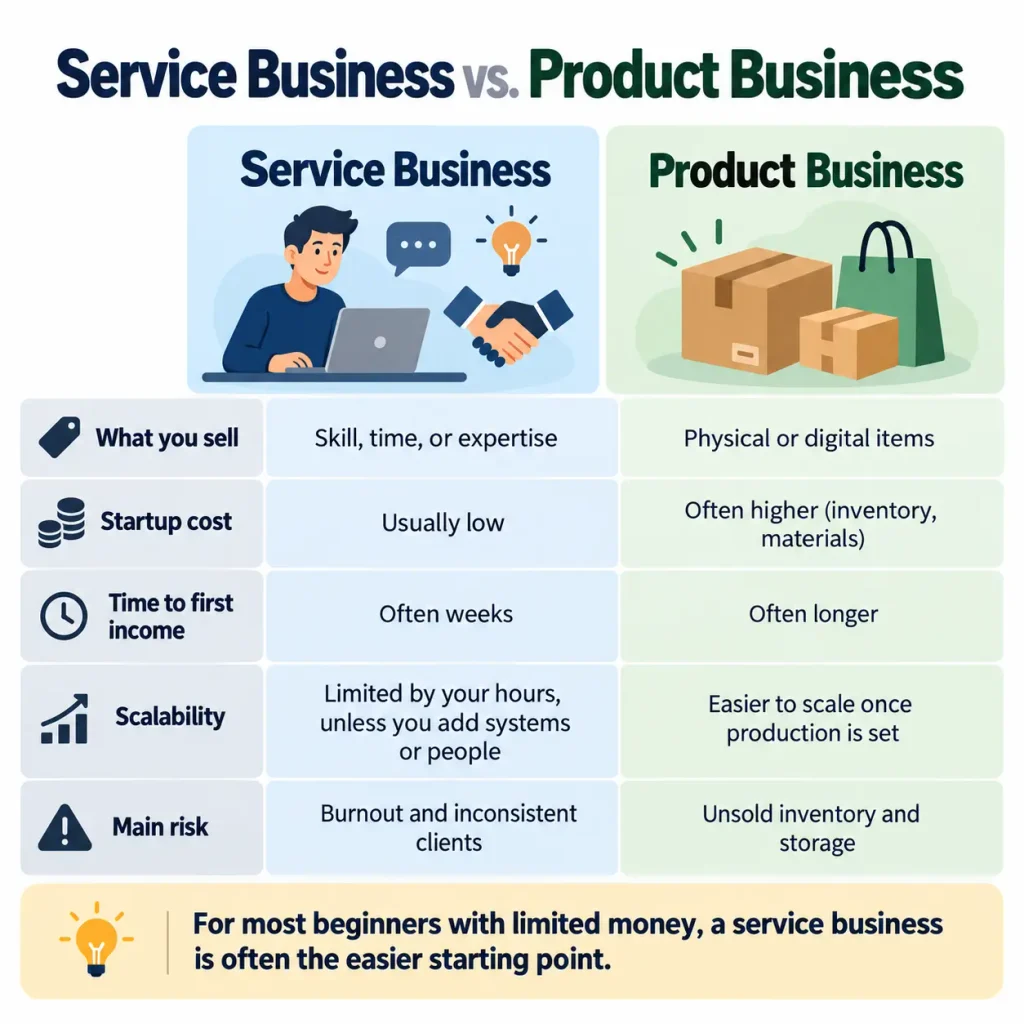
| Service Business | Product Business | |
|---|---|---|
| What you sell | Skill, time, or expertise | Physical or digital items |
| Startup cost | Usually low | Often higher (inventory, materials) |
| Time to first income | Often weeks | Often longer |
| Scalability | Limited by your hours, unless you add systems or people | Easier to scale once production is set |
| Main risk | Burnout and inconsistent clients | Unsold inventory and storage |
Neither is better in every case. For most beginners with limited money, though, a service business is the easier starting point.
Pros and Cons of Service Based Businesses
Pros:
- Low startup costs
- Fast to launch, often within days
- No inventory to manage
- You can start with skills you already have
- Direct client feedback helps you improve quickly
Cons:
- Income is tied to your time, so there’s a ceiling
- Client work can be uneven (busy months, then quiet ones)
- You handle sales, delivery, and admin yourself
- Difficult clients can drain energy
Knowing these trade-offs helps you plan for them, such as saving a cash buffer for slow months and setting clear contracts from the start.
How to Choose a Service Business Idea
Use these four questions before choosing from the list.
1. What can I already do well? Think about past jobs, hobbies, and what friends ask you for help with. Skills you already have shorten the time to your first client.
2. Who would pay for it? Pick a specific group, such as small business owners, busy parents, or students. A defined audience is easier to reach.
3. Online or local? Online services (writing, design, bookkeeping) can reach anyone. Local services (organizing, pet sitting) are limited by distance but often face less competition.
4. Does it fit my life? Consider your energy, schedule, and comfort with people. Some services involve a lot of live conversation, and others are quiet, independent work.
Quick Comparison of the 10 Ideas
| Business Idea | Online or Local | Startup Cost | Experience Needed |
|---|---|---|---|
| Freelance writing | Online | Very low | Low–Medium |
| Virtual assistant | Online | Very low | Low |
| Bookkeeping | Online | Low–Medium | Medium |
| Social media management | Online | Low | Low–Medium |
| Graphic and web design | Online | Low | Medium |
| Online tutoring | Online | Very low | Medium |
| Home organizing | Local (some virtual) | Low | Low |
| Pet sitting and dog walking | Local | Low | Low |
| Coaching and consulting | Online or local | Low | Medium–High |
| Video editing | Online | Low | Medium |
10 Service Based Businesses You Can Run From Home

1. Freelance Writing and Copywriting
Businesses need blog posts, website pages, emails, product descriptions, and editing. If you write clearly and meet deadlines, you can build a steady client base.
How to start:
- Create 3–5 writing samples on topics you know
- Choose a niche, such as health, finance, travel, or software
- Pitch small businesses and publications directly
- Use freelance platforms for early work, then move toward direct clients
Watch out for: Very low-paying content mills. They can offer practice but rarely lead to a sustainable income.
2. Virtual Assistant
A virtual assistant (VA) handles remote admin work: email, calendars, data entry, customer support, research, and travel planning. Busy founders and small teams often prefer a VA over a full-time hire.
How to start:
- Pick 3–4 tasks you can do confidently
- Focus on one type of client, such as coaches, real estate agents, or online sellers
- Learn common tools like Google Workspace, Trello, Asana, and Calendly
- Offer monthly packages for steady income
Tip: A niche is easier to sell than a general offer. “VA for podcasters” is clearer than “VA for anyone.”
3. Bookkeeping
Bookkeepers track income and expenses, reconcile accounts, and prepare simple reports. Many small business owners dislike this work and gladly pay someone reliable.
How to start:
- Learn software such as QuickBooks or Xero through their official training
- Consider a bookkeeping course or certification if you’re new
- Start with freelancers and local businesses with simple finances
Important: Bookkeeping is not tax preparation or accounting. Know where your service ends, and refer clients to a licensed CPA when needed. Rules for paid tax preparation vary, so check IRS guidance before offering anything beyond bookkeeping.
4. Social Media Management
Many small businesses know they should post consistently but lack the time. You can plan content, write captions, schedule posts, respond to comments, and report on results.
How to start:
- Choose one or two platforms you understand well
- Build a sample content calendar for a business you’d like to work with
- Use free versions of Canva and scheduling tools
- Offer a small trial month to your first client
Tip: Social media management also pairs well with other low-cost options, and these best online businesses you can start with no money show how it compares.
5. Graphic and Web Design
Logos, brand kits, social graphics, flyers, presentations, and simple websites are in constant demand. Free and low-cost tools make it possible to begin without heavy software costs.
How to start:
- Build 5–8 samples, even for fictional businesses
- Focus on one specialty, such as social media templates or small-business websites
- Show your work on a free portfolio page
- Price by project and define the number of revisions
Be careful: Check licensing for fonts, images, and templates before using them in client work.
6. Online Tutoring
Parents and adult learners pay for one-on-one help in math, reading, science, languages, music, and test prep. Tutoring is flexible and often works well around other commitments.
How to start:
- Choose a subject and learner level
- Prepare a simple lesson outline and a short free trial lesson
- Join a tutoring platform or find students through community groups
- Use a reliable video tool and a shared digital whiteboard
Good fit for: Students, former teachers, bilingual speakers, and subject experts.
7. Home Organizing and Decluttering
Professional organizers help people sort closets, kitchens, garages, and home offices. Some also offer virtual sessions where clients get a plan and do the work themselves.
How to start:
- Practice on your own space and with friends (with permission for photos)
- Offer flat-rate packages like “closet reset” or “pantry makeover”
- Partner with real estate agents, movers, and cleaners
- Build trust with clear boundaries and privacy rules
Skill needed: Patience and good judgment, since you’re working in personal spaces.
8. Pet Sitting and Dog Walking
Pet owners need help during travel and long workdays. It’s one of the lowest-cost local service businesses to start.
How to start:
- Build experience with friends’ and neighbors’ pets
- Consider pet first-aid training
- Look into business insurance and bonding
- Write a simple service agreement covering emergencies, vet contacts, and cancellations
Tip: Trust is everything. References and a meet-and-greet before the first booking go a long way.
9. Coaching and Consulting
If you have professional experience in career planning, fitness, parenting, business, or language learning, you can coach others. Experience can be your strongest asset here.
How to start:
- Define the specific result you help people achieve
- Start with a few clients at an introductory rate and collect testimonials
- Offer a clear package, such as a 6-week program, rather than vague “sessions”
- Be careful about claims and promises
Important: Health, nutrition, legal, financial, and mental health topics require care. Don’t give advice outside your qualifications, and don’t promise outcomes you can’t guarantee.
10. Video Editing
Creators, small brands, course makers, and podcasters need editors for short clips, YouTube videos, and social content. Editing can be done entirely from home on a laptop.
How to start:
- Learn editing basics with free or low-cost software
- Edit 3–5 sample videos using free footage or your own
- Specialize in one format, such as short-form clips or podcast highlights
- Reach out to creators whose content could use better pacing and captions
Be careful: Use only music, footage, and images you have rights to, and keep client files organized and backed up.
Best Service Business Ideas for Your Situation
| Your Situation | Ideas to Consider |
|---|---|
| Beginner, little experience | Virtual assistant, pet sitting, organizing, social media management |
| Little or no money | Freelance writing, virtual assistant, tutoring, social media management |
| Introverts | Freelance writing, bookkeeping, design, video editing |
| Students | Tutoring, freelance writing, social media management, design |
| Stay-at-home moms | Virtual assistant, freelance writing, tutoring, bookkeeping |
| Women starting a business | Virtual assistant, coaching, organizing, design |
| Full-time job | Freelance writing, design, video editing, tutoring |
For women and moms: Look for services with flexible hours and clear deadlines, since they fit around family routines more easily. If you want a wider list, see these small business ideas for women you can start from home.
For introverts: Writing, bookkeeping, design, and editing involve less live interaction. You’ll still need to communicate with clients, but much of it can happen by email or message.
For people with a full-time job: Check your employment contract for conflict-of-interest or side-work rules, and keep client work off work hours and equipment.
How to Start a Service Based Business From Home
Step 1: Choose One Service and One Audience
Write one sentence: “I help [specific person] get [specific result] through [specific service].” For example: “I help local bakeries stay consistent on Instagram so they get more custom orders.”
Step 2: Build Proof
If you have no clients yet, make samples. Two to five examples of your work can replace experience in the first few weeks.
Step 3: Set Your Packages and Prices
Offer simple, clear options instead of custom quotes for everything. The next section explains how to price.
Step 4: Handle the Basics
Open a separate business bank account, track income and expenses, and check your local registration and tax requirements.
Step 5: Create a Simple Online Presence
A one-page website or a clean profile with your services, prices, samples, and contact details is enough. If you serve a local area, add a Google Business Profile.
Step 6: Find Your First Clients
See the section on getting clients below.
Step 7: Use a Simple Contract
Put scope, price, deadlines, revisions, and payment terms in writing, even for small jobs. This protects both you and your client.
How to Price Your Services
Price based on the value you deliver, your costs, and what similar providers charge. There are four common models:
- Hourly: Simple to explain, but it rewards slowness and caps your income.
- Per project: A flat fee for a defined result, such as a logo or a website page set.
- Retainer or monthly package: Ongoing work for a fixed monthly fee, good for steady income.
- Value-based: Pricing tied to the result for the client, usually used by experienced consultants.
A simple starting formula: decide the income you need per hour, add business costs and taxes, and make sure your price covers unpaid time such as admin and marketing. Avoid being the cheapest option. Rock-bottom prices can attract difficult clients and make the business hard to sustain.
How to Find Your First Client
Your first client usually comes from conversation, not advertising.
- Tell your network. Say what you offer and who it’s for. Friends, former coworkers, and relatives often know someone who needs help.
- Join relevant communities. Facebook groups, LinkedIn, and niche forums are full of people asking for help. Contribute first and follow each group’s rules before promoting.
- Send helpful outreach. Instead of “Do you need a freelancer?”, point out one specific improvement you could make to their page or process.
- Use freelance platforms. Upwork, Fiverr, and similar sites can help beginners find early projects, though competition and fees are real.
- Offer a discounted first project. In exchange, ask for a testimonial you can show future clients.
How Much Does It Cost to Start a Service Business?
Many service businesses can start at close to $0. Typical costs include:
- Tools and software: design, accounting, scheduling, or video tools
- Website and domain: a modest yearly cost
- Business registration: varies by state and city
- Insurance: especially useful for in-person services like pet care and organizing
- Training or certification: optional but helpful for areas like bookkeeping
Start with free versions of tools and upgrade only when a paid tool saves time or helps you earn more.
Do You Need a License for a Home Service Business?
Often, yes, though requirements depend on your state, city, and service. Check these:
- Business structure: Most solo owners start as sole proprietors. An LLC adds liability protection but involves state fees.
- Business name: If you operate under a name other than your own, you may need to register a DBA (“doing business as”) name.
- EIN: A free Employer Identification Number from the IRS is optional for many sole proprietors but useful for banking and keeping your Social Security number off client forms. Apply only through the official IRS website.
- Local licenses and zoning: Some cities require a business license or home occupation permit. Renters and HOA residents should review their lease or community rules too.
- Professional licenses: Some services, such as childcare, certain wellness services, and tax preparation, have specific requirements.
- Insurance: Consider liability coverage if you work in clients’ homes or handle their property.
- Taxes: Self-employed people generally pay income tax plus self-employment tax and often make quarterly estimated payments. You may qualify for a home office deduction if you use part of your home regularly and exclusively for business.
The U.S. Small Business Administration and the IRS both publish beginner guidance, and a local accountant can help you set things up correctly.
This is general information, not legal or tax advice.
Starting in the UK? The core ideas in this guide still apply, but registration and tax are different. Self-employed people in the UK generally register as sole traders with HMRC, and local rules differ, so check official UK government guidance before you launch.
How to Scale a Service Based Business
Because your time is limited, growth usually means earning more per hour or reducing hands-on work. Common options include:
- Raise your prices as your skills and reputation grow
- Productize your service by turning repeated work into fixed packages
- Specialize in a niche so you can charge more for expertise
- Use templates and systems to deliver faster
- Subcontract or hire help for repeatable tasks
- Add digital products or courses based on what you teach clients repeatedly
Scale only after your core service runs smoothly and clients are happy.
Common Mistakes to Avoid
- Offering everything to everyone. A narrow niche is easier to market.
- Underpricing. It leads to burnout and resentment.
- Working without a contract. Unclear scope leads to disputes and unpaid work.
- Depending on one client. Aim to have more than one source of income.
- Ignoring taxes. Set aside part of every payment for taxes.
- Skipping marketing when busy. Keep a steady trickle of outreach so you’re never starting from zero.
- Not setting boundaries. Decide your working hours and response times.
Are Service Based Businesses Profitable?
They can be, mainly because costs are low and you control your prices. Profit depends on your pricing, your niche, how consistently you find clients, and how efficiently you work. A service business with almost no expenses can keep a large share of what it earns, but it can also be limited by your available hours.
A realistic approach is to treat the first few months as a test, track your income and hours, and adjust.
Frequently Asked Questions
What are examples of service based businesses?
Examples include freelance writing, virtual assisting, bookkeeping, graphic design, tutoring, coaching, consulting, cleaning, organizing, and pet sitting. If you sell your time or expertise to get a result for a client, it’s a service business.
How do I start a service based business with no money?
Choose a skill you already have, build a few samples, and use free tools and platforms. Reach out to potential clients directly, and reinvest early earnings into better tools or training.
What is the best service based business to start from home?
There’s no single best option. Virtual assisting, freelance writing, and tutoring are popular because they need little equipment and have low barriers. The best choice depends on your skills, schedule, and comfort with people.
Do I need a license to run a service business from home?
Often you need at least a local business license or registration, and some services have extra rules. Check your state, city, and industry requirements before you start.
How do I get clients as a beginner?
Start with your personal network, then join online communities, send helpful outreach, and offer a discounted first project in exchange for a testimonial. Consistency matters more than any single tactic.
How much should I charge for my services?
Consider your costs, your desired income, and market rates. Beginners often start with project-based or package pricing and raise prices as they gain experience and testimonials.
Can I run a service business alongside a full-time job?
Often yes, if you choose services with flexible schedules and clear deadlines. Check your employment contract for restrictions, and avoid using work time or equipment.
How can I grow a service business beyond trading time for money?
Raise your rates, package your services, specialize in a niche, use templates, hire help, or add products like courses and templates. Do this once your core service is stable.
Final Thoughts
Service based businesses give you one of the lowest-risk ways to start earning from home. They reward skills you already have, they need little money, and they let you learn quickly from real clients.
Here’s a practical next step. Pick one idea from this list, write your one-sentence offer, and build two or three samples this week. Then message five people who could use your help. Once you have a paying client, you can refine your pricing, tighten your process, and grow from there.
Looking for more business ideas? Explore more guides on Bunbin Magazine.