

The best small business ideas for women are the ones that fit your skills, your schedule, and the money you can put in right now. You don’t need a big budget, a business degree, or a storefront. Many home-based businesses start with a laptop, a phone, and a few focused hours a week.
This guide covers 15 home-based business ideas, with realistic startup costs, the skills each one needs, and how to get your first customers. You’ll also find advice for specific situations (stay-at-home moms, tight budgets, women over 40 or 50, full-time workers), plus a step-by-step launch plan, legal basics, and answers to common questions.
A note on numbers: the cost ranges below are rough, general estimates based on typical setups, not guarantees. Your costs and income will depend on your market, pricing, and effort.
What Business Can a Woman Start From Home?
A woman can start almost any business that doesn’t need a commercial space. The most common options fall into four groups:
- Service businesses: virtual assisting, bookkeeping, social media management, tutoring, organizing
- Creative businesses: handmade goods, graphic design, digital templates, photography
- Product businesses: online resale, print on demand, home baking (where local law allows)
- Knowledge businesses: coaching, courses, blogging, consulting
Service businesses are usually the cheapest to start because you’re selling time and skill, not inventory.
How to Choose the Right Home Business Idea
Before you pick from the list, run each idea through three filters.
1. Skills you already have. Think about what friends ask you for help with, what you did in past jobs, and what you do well without much effort. The easiest business to start is usually one built on skills you’ve already paid for with years of experience.
2. Money and time you can spare. Be honest about both. A business that needs $3,000 and 30 hours a week won’t work if you have $300 and 8 hours.
3. Demand. Ask whether people are already paying for this and whether you can reach them. Search for the service on Google, Instagram, Facebook groups, or marketplaces like Etsy and Upwork. If nobody sells it, there may be no demand. If a few people sell it successfully, that’s a good sign.
Quick Comparison of the 15 Ideas
| Business Idea | Typical Startup Cost | Best For | Experience Needed |
|---|---|---|---|
| Virtual assistant | Very low | Organized, reliable people | Low |
| Freelance writing/editing | Very low | Strong writers | Low–Medium |
| Social media management | Low | Creative, social-savvy people | Low–Medium |
| Bookkeeping | Low–Medium | Detail-oriented people | Medium |
| Digital products | Low | Designers, planners, teachers | Low–Medium |
| Handmade goods | Low–Medium | Crafters | Low |
| Online tutoring | Very low | Teachers, subject experts | Medium |
| Fashion resale/styling | Low | Style-minded people | Low |
| Home bakery | Medium | Bakers and cooks | Medium |
| Pet sitting | Low | Animal lovers | Low |
| Home organizing | Low | Tidy, practical people | Low |
| Online coaching | Low | Experienced professionals | Medium–High |
| Blogging/content creation | Low | Patient, consistent creators | Low |
| Home-based childcare | Medium | Caregivers | Medium (licensing) |
| Print on demand store | Low | Designers, niche thinkers | Low |
15 Home-Based Business Ideas for Women

1. Virtual Assistant
A virtual assistant (VA) handles remote admin work for busy owners and executives: email, scheduling, data entry, customer support, travel booking, and simple research.
Why it works: Small business owners often need help but can’t afford a full-time hire. A VA fills the gap by the hour or on a monthly package.
How to start:
- Choose 3–5 services you can do confidently
- Pick a niche, such as real estate agents, coaches, or online shop owners
- Learn the tools clients use (Google Workspace, Calendly, Trello, Asana, Slack)
- Start with one or two clients, then raise your rates as you get testimonials
Tip: Specialists charge more than generalists. “VA for podcasters” is easier to market than “VA for everyone.”
2. Freelance Writing and Editing
Businesses always need blog posts, website copy, newsletters, product descriptions, and editing. If you write clearly, this is one of the lowest-cost options.
How to start:
- Build 3–5 writing samples (you can write them yourself)
- Choose a niche you understand, such as health, finance, parenting, or fashion
- Pitch small businesses and blogs directly
- Use freelance platforms to find first clients, then move toward direct clients
Watch out for: Very low-paying content mills. They can help you gain experience but rarely build a sustainable income.
3. Social Media Management
Many small businesses know they should post consistently but don’t have the time. You can plan content, write captions, schedule posts, reply to comments, and report on results.
How to start:
- Pick one or two platforms to focus on
- Create a sample content calendar for a business you’d like to work with
- Offer a small trial package
- Learn the basics of free tools like Canva and a scheduling app
Tip: This idea suits women who already enjoy social media and notice what makes posts work.
4. Bookkeeping Services
Bookkeepers track income and expenses, reconcile bank accounts, and prepare reports. Small business owners often dread this work and gladly pay someone reliable.
How to start:
- Learn popular software like QuickBooks or Xero through their official tutorials
- Consider a bookkeeping course or certification if you’re new
- Start with small clients, such as freelancers and local shops
Important: Bookkeeping is not the same as tax preparation or accounting. Know where your services end, and refer clients to a licensed CPA when needed. Rules for paid tax preparation vary, so check the IRS guidance for tax professionals before offering anything beyond bookkeeping.
5. Digital Products (Templates, Planners, Printables)
Digital products are created once and sold many times. Examples include budget planners, wedding checklists, resume templates, social media templates, and lesson-plan bundles. This is the closest thing on the list to passive income, though it takes real work upfront and ongoing marketing.
How to start:
- Find a specific problem people want solved, such as “meal planner for busy moms”
- Design the product in Canva or similar software
- Sell through Etsy, your own website, or a platform like Gumroad
- Make several related products, because one item rarely brings steady sales
Reality check: Popular niches are crowded. A narrow niche usually beats a broad one.
6. Handmade Goods and Crafts
Candles, jewelry, crochet items, soap, ceramics, greeting cards, and personalized gifts all sell online. This is a natural choice for women who love crafts and want a creative business.
How to start:
- Make a small batch and test it with friends or at a local market
- Calculate your costs carefully, including materials, packaging, platform fees, shipping, and your time
- Photograph your products in natural light
- Open a shop on Etsy or a similar marketplace
Safety note: Items like candles, soap, and cosmetics may be subject to labeling and safety rules. Check with the U.S. Consumer Product Safety Commission and the FDA’s cosmetics guidance before selling.
Common mistake: Underpricing. Many beginners charge only for materials and forget their labor.
7. Online Tutoring
If you’re strong in math, reading, science, languages, music, or test preparation, you can tutor students over video call. Parents and adult learners both pay for personalized help.
How to start:
- Choose a subject and age group
- Decide whether to join a tutoring platform or find clients on your own
- Prepare simple lesson plans and a free trial lesson
- Use a reliable video tool and a digital whiteboard
Good fit for: Former teachers, college graduates, and bilingual women.
8. Fashion Resale and Personal Styling
Thrifting and reselling clothing, accessories, or vintage pieces can start with items already in your closet. Personal styling lets you use your fashion sense to help clients build wardrobes, either virtually or in person.
How to start:
- Test the market by selling 10–20 items on Poshmark, Depop, eBay, or Vinted
- Learn which brands and styles sell quickly
- Photograph items clearly and write honest descriptions
- For styling, offer a low-priced closet review or virtual styling session first
Tip: Styling clients value taste and trust. Show your eye through before-and-after examples and styled outfits.
9. Home Bakery or Cottage Food Business
Cakes, cookies, bread, jams, and other shelf-stable foods can be profitable, especially for custom orders like birthdays and weddings.
Important: Selling food from home is regulated. Most U.S. states have cottage food laws, but each state sets its own rules on what you can sell, where you can sell it, labeling, sales limits, and whether you need a permit. Check your state’s department of health or agriculture before selling anything.
How to start:
- Read your state’s cottage food rules first
- Start with two or three signature items
- Take clear photos and collect reviews
- Sell through local Facebook groups, farmers markets (if permitted), and word of mouth
10. Pet Sitting and Dog Walking
Pet owners often need help when they travel or work long hours. This is one of the easiest businesses to start with little money.
How to start:
- Gain experience by caring for friends’ and neighbors’ pets
- Consider pet first-aid training
- Look into business insurance and bonding
- Create a simple service agreement covering emergencies, vet contacts, and cancellation terms
Tip: Trust is everything here. References and a professional meet-and-greet go a long way.
11. Home Organizing and Decluttering
Professional organizers help people sort closets, kitchens, garages, and move-related chaos. Some work in person, and others offer virtual consultations.
How to start:
- Practice on your own home and friends’ homes
- Take before-and-after photos with permission
- Offer a flat-rate package, such as “closet reset” or “pantry makeover”
- Explore partnerships with real estate agents and movers
Skill needed: Patience and good judgment, since you’re working in people’s personal spaces.
12. Online Coaching and Consulting
If you have professional experience in career planning, fitness, nutrition, parenting, language learning, or business, you can coach others. Women with years of workplace expertise often find this a natural next step.
How to start:
- Define the specific result you help people achieve
- Start with a small number of clients at an introductory rate
- Collect testimonials before raising prices
- Be careful about claims
Important: Health, nutrition, and mental health coaching require care. Don’t offer medical advice or promise outcomes you can’t guarantee, and know where your qualifications end.
13. Blogging and Content Creation
Blogs, YouTube channels, newsletters, and podcasts can earn money through ads, affiliate links, sponsorships, and your own products. This is a slow-build business, and income is rarely quick.
How to start:
- Pick a topic you can write about for years
- Choose a clear audience
- Publish consistently for several months before judging results
- Learn basic search optimization and email list building
Tip: Don’t count on it as your only income early on. It works well as a side hustle alongside other work. If you use affiliate links, follow the Federal Trade Commission’s endorsement and disclosure guidelines.
14. Home-Based Childcare
Licensed in-home childcare is a real, in-demand business, especially in areas where daycare is expensive or has long waitlists.
Important: Childcare is heavily regulated. Licensing requirements, group size limits, inspections, safety rules, and training vary by state. Contact your state’s child care licensing agency before you advertise.
Good fit for: Women who are patient, safety-minded, and comfortable with a busy home environment. Keep in mind this isn’t flexible work, since you’re on duty during set hours.
15. Print-on-Demand or Niche Online Store
With print on demand, a supplier prints and ships items like mugs, shirts, and tote bags when a customer orders. You never hold inventory.
How to start:
- Choose a narrow audience, such as nurses, teachers, plant lovers, or dog moms
- Create original designs (don’t copy copyrighted or trademarked material)
- Order samples to check quality
- Promote through social media, Pinterest, and email
Reality check: Margins can be thin, and competition is high. Success usually comes from a clear niche and strong branding.
Business Ideas Based on Your Situation
Your life stage matters as much as the idea itself. Here’s how the options above match common situations.
| Your Situation | Ideas to Consider |
|---|---|
| Stay-at-home moms | Virtual assistant, digital products, online tutoring, freelance writing, blogging |
| Little or no money | Freelance writing, virtual assisting, pet sitting, social media management |
| Starting with about $500 | Fashion resale, handmade goods, digital products, organizing, print on demand |
| Women over 40 or 50 | Coaching or consulting, bookkeeping, tutoring, freelance editing |
| No experience | Pet sitting, organizing, fashion resale, virtual assisting |
| Full-time job | Digital products, blogging, freelance projects, print on demand |
| Love of crafts | Handmade goods, digital patterns, custom gifts |
| Fashion-focused | Resale, styling, content creation |
For women over 40 or 50: Your career history is an asset. Clients often value maturity, reliability, and industry knowledge. Consulting, coaching, and professional services let you use experience you already have.
For women with a full-time job: Choose a business you can run in short, scheduled blocks, like two evenings and one weekend morning. Check your employment contract for conflict-of-interest or side-work rules first.
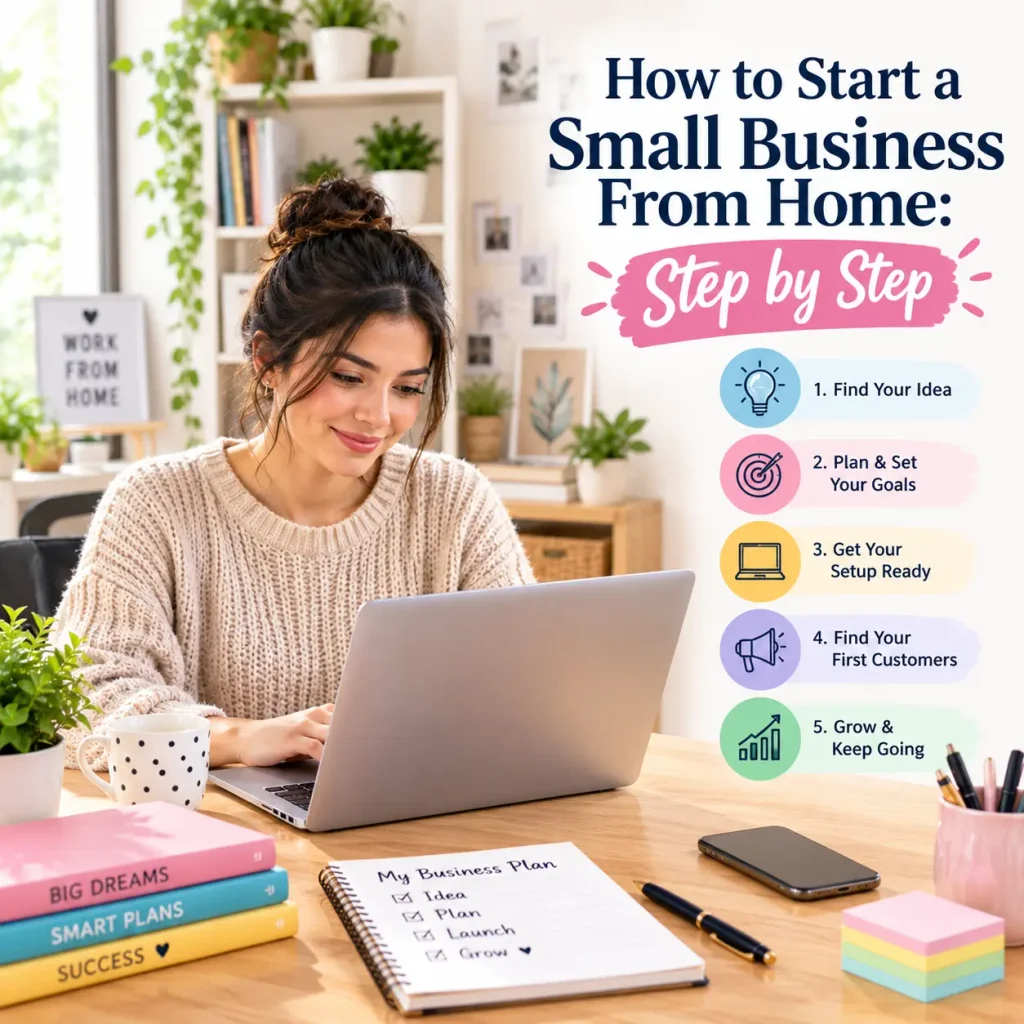
How to Start a Small Business From Home: Step by Step
Step 1: Pick One Idea and Test It
Don’t try to launch three businesses at once. Choose one, then test it with a small offer. A single paying customer teaches you more than a month of planning.
Step 2: Define Your Customer and Your Offer
Write one sentence: “I help [specific person] get [specific result] through [specific service or product].” For example: “I help small bakeries manage their Instagram so they get more custom orders.”
Step 3: Set Your Prices
Price based on your costs, the time involved, and what similar businesses charge. Don’t pick the lowest number just to attract clients. Very low prices can make a business unsustainable and attract difficult customers.
Step 4: Handle the Legal Basics
Read the next section carefully. Skipping this step can cause problems later.
Step 5: Open a Separate Bank Account
Keep business money apart from personal money. It makes taxes, budgeting, and tracking profit much easier.
Step 6: Build a Simple Online Presence
You don’t need a large website to begin. A one-page site or a clean profile with your services, prices, samples, and contact details is enough at first. Add a Google Business Profile if you serve local customers.
Step 7: Get Your First Customers
Tell people what you do. Start with friends, former coworkers, neighbors, and local community groups. Ask early customers for a short testimonial.
Step 8: Track Your Numbers
Record income, expenses, hours worked, and where each customer came from. After a few months, you’ll see what’s working.
Do You Need a License or Registration to Run a Home Business?
Often, yes, though the requirements depend on your state, city, and business type. Here’s what to check.
Business structure. Most solo owners start as a sole proprietor, which is the simplest option. An LLC can separate personal and business liability, but it involves state filing fees. The U.S. Small Business Administration (SBA) explains how to choose a structure and launch a business.
Business name. If you operate under a name other than your own, you may need to register a “doing business as” (DBA) name with your state or county.
EIN. You can get a free Employer Identification Number from the IRS. Not every sole proprietor needs one, but it’s useful for opening a business bank account and keeps your Social Security number off client forms. Apply only through the official IRS website, because third-party sites may charge unnecessary fees.
Local licenses and zoning. Some cities require a general business license or a home occupation permit. Check your city or county website, and if you rent or live in an HOA community, review your lease or rules too.
Sales tax. If you sell physical products, you may need a sales tax permit. Rules differ by state, and marketplaces may collect tax for you in some situations, so confirm what applies to you.
Industry-specific rules. Food, childcare, cosmetics, and some wellness services have extra requirements.
Taxes. Self-employed people generally pay income tax plus self-employment tax, and often make quarterly estimated payments. The IRS has a small business and self-employed section on its website. You may qualify for a home office deduction if you use part of your home regularly and exclusively for business. A local CPA can help you set this up correctly.
This is general information, not legal or tax advice.
How Much Money Do You Need to Start a Home Business?
It ranges from almost nothing to a few thousand dollars.
- Under $100: Freelance writing, virtual assisting, pet sitting, and tutoring. You mostly need a laptop, internet, and a simple portfolio.
- $100–$500: Fashion resale, digital products, organizing supplies, basic website, and small craft batches.
- $500–$2,500: Home bakery equipment, craft materials, professional training, insurance, and a branded website.
Common early expenses include a business license, domain name and hosting, software subscriptions, insurance, packaging, and marketing. Keep an emergency buffer if possible, since early income is often unpredictable.
Funding and Free Help
If you want guidance or capital, these are good starting points:
- Women’s Business Centers: SBA-supported centers that offer training and counseling for women entrepreneurs
- SCORE: free mentoring from experienced business volunteers
- Small local grants and microloans: availability varies, so research each program’s terms carefully
Be cautious of anyone who promises guaranteed grants or “easy money” for a fee.
How to Market a Small Business Online
You don’t need a big budget. You need consistency.
Pick one or two channels. Trying everything leads to burnout. Choose where your customers already spend time, such as Instagram, Pinterest, LinkedIn, or local Facebook groups.
Show proof. Share before-and-after results, reviews, behind-the-scenes photos, and examples of your work.
Use search. A basic website with clear service pages helps people find you. If you serve a local area, a Google Business Profile can bring in nearby customers.
Build an email list. Social platforms change, but an email list is something you own. Even a short monthly newsletter helps you stay in touch with past and future customers.
Ask for referrals. Happy customers are often your best marketing. Simply asking, “Do you know anyone else who could use this?” can bring steady work.
Common Mistakes to Avoid
- Waiting for the perfect idea. A good-enough idea, tested quickly, beats a perfect plan that never launches.
- Underpricing. Low prices make it hard to cover costs and time.
- Mixing personal and business money. This complicates taxes and makes it harder to see profit.
- Ignoring the legal side. Check permits, insurance, and tax rules early.
- Buying expensive tools too soon. Prove demand before investing heavily.
- Falling for scams. Be wary of “business opportunities” that require upfront fees, recruiting, or promise unrealistic income.
- Working without boundaries. Home businesses can swallow your whole day. Set working hours, even if they’re short.
Is a Home Business Worth It?
For many women, yes, but it depends on your expectations. A home business can offer flexibility, independence, and the chance to build something of your own. It also involves uncertain income, self-discipline, and doing many jobs yourself.
Most home businesses grow gradually. Treat the first few months as a testing period, not a final verdict. If you need steady income right away, it may be wiser to start as a side hustle while keeping your current income.
Frequently Asked Questions for Small Business Ideas for Women
What is the best small business for a woman to start?
There’s no single best option, because it depends on your skills, budget, and time. Service businesses like virtual assisting, freelance writing, bookkeeping, and tutoring tend to have low startup costs and fast starts, which makes them popular choices.
How can I start a business with no money?
Choose a service business where you sell your time and skill, such as freelancing, pet sitting, or virtual assisting. Use free tools, work from your existing computer, and reinvest early earnings into the business.
What are the easiest businesses to start from home?
Pet sitting, organizing, virtual assisting, and freelance writing are among the easiest to launch because they need little equipment and few startup costs. Easy to start doesn’t mean easy to grow, though. You’ll still need to find customers and deliver consistently.
Do I need an LLC to run a home business?
No. Many solo owners begin as sole proprietors. An LLC can add liability protection but comes with state fees and paperwork. Consider talking to a business attorney or accountant if you’re unsure.
Can I run a business from home while working full time?
Often yes. Choose a business that fits short, scheduled blocks of time, such as digital products or freelance projects. Check your employment agreement for any restrictions on side work.
What are the best passive income ideas for women?
Digital products, blogging, and online courses can generate income over time after the initial work. They’re rarely fully passive, since you’ll still update, promote, and support them. Treat “passive” as “less hands-on later,” not “effortless.”
How do I find my niche?
List your skills, interests, and past experience. Then look for a specific group of people with a problem you can solve. A narrow niche, like “bookkeeping for freelance photographers,” is easier to market than a broad one.
How long does it take for a home business to make money?
It varies widely. Some service businesses earn their first income within weeks if you contact potential clients directly. Product and content businesses often take months. Plan your finances for a slower start.
Final Thoughts
You don’t need to start big to start well. The strongest small business ideas for women build on skills they already have, require a manageable investment, and solve a real problem for a specific group of people.
Here’s a simple next step. Pick two ideas from this list, spend this week researching demand for each, then try to land one paying customer or sale from your favorite. That small test will tell you far more than endless planning. Once you have proof of demand, you can handle the legal setup, branding, and growth with confidence.
Looking for more inspiration? Explore more guides on Bunbin Magazine.