
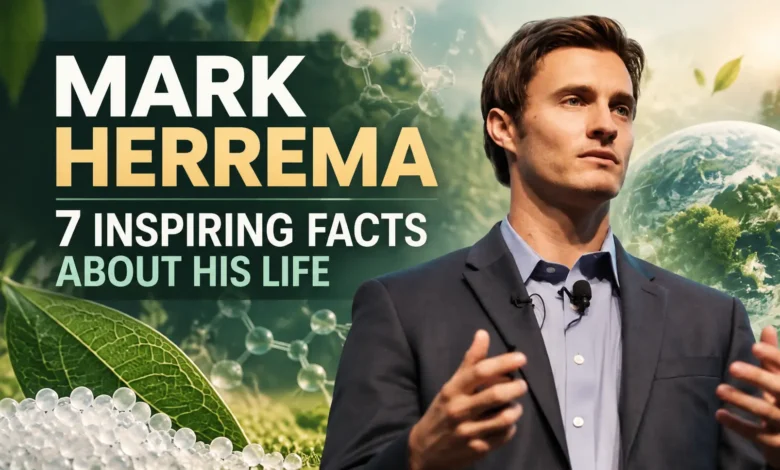
Mark Herrema is the co-founder and CEO of Newlight Technologies, the California company behind AirCarbon, a plastic-like material made from greenhouse gas. He did not train as a chemist or an engineer. He studied politics at Princeton, then spent about a decade working on a problem most people had written off as too expensive to solve.
If you searched for Mark Herrema, you probably want a quick answer to who he is, what he built and why people find his story worth telling. This guide covers all of that: his education, his career, the science behind AirCarbon in plain English, his awards, and what is (and is not) publicly known about his age, family and net worth.
Everything below is based on sources such as the US Environmental Protection Agency, the World Economic Forum, Princeton Alumni Weekly, the Smithsonian magazine and interviews with Herrema himself. Where information is not publicly confirmed, we say so rather than guess.
Who Is Mark Herrema? (Quick Answer)
Mark Herrema is an American entrepreneur and inventor. He co-founded Newlight Technologies in 2003 and serves as its chief executive officer. Newlight develops AirCarbon, a material made by combining air and carbon from methane with a natural biological process.
Here are the essentials at a glance:
| Detail | What is publicly known |
|---|---|
| Full name | Mark Herrema |
| Role | Co-founder and CEO, Newlight Technologies |
| Co-founder | Kenton Kimmel (co-founder and CTO) |
| Education | Princeton University, BA in Politics and Political Theory (magna cum laude), with extra coursework in physics, mathematics and chemistry |
| Known for | AirCarbon, a carbon-negative biomaterial that can replace plastic |
| Company base | Huntington Beach, California (earlier described as Irvine and Costa Mesa) |
| Major recognition | 2016 Presidential Green Chemistry Challenge Award (for Newlight), World Economic Forum Technology Pioneer |
Now let’s look at the seven facts that make his story stand out.
Fact 1: He Studied Politics, Not Science
The most surprising part of the Mark Herrema biography is his degree. According to his official biographies, he graduated magna cum laude from Princeton University with a Bachelor of Arts in Politics and Political Theory. He also took additional courses in physics, mathematics and chemistry.
That mix matters. Politics teaches you how systems, incentives and markets behave. Science gives you the tools to change a physical process. Herrema’s story sits right where those two meet.
His Senior Thesis Was About Hunger
A Smithsonian magazine profile reports that for his senior thesis he looked at farm subsidies and worked out a market-driven idea for tackling world hunger. In other words, he was already thinking about large global problems and asking how economics could solve them, long before he turned to climate change.
Why This Matters for Aspiring Founders
Herrema’s path is a useful reminder that a founder does not need a degree that matches the industry. What he needed was curiosity, a clear problem and the willingness to learn the science and bring the right people in. If you enjoy reading about founders who took unexpected routes, you may also like our celebrity and entrepreneur biographies.
Fact 2: He Co-Founded Newlight With a High School Classmate
Newlight Technologies was founded in 2003. Herrema started it with Kenton Kimmel, who, according to the Smithsonian, was a high school classmate. Kimmel later became the company’s chief technology officer, which means the pair split the work in a sensible way: one leading the business, the other the technology.
The founding idea was simple to state and very hard to do. Instead of treating greenhouse gas as waste, treat it as a raw material. The company’s own description is that it set out to pull carbon from the air and use it to make high-performance, cost-effective, carbon-negative plastic.
Early Life and Education: What We Know
Mark Herrema’s early life is not documented in much detail. Beyond the fact that he met his future co-founder at school, there is little reliable public information about his childhood, hometown or family background. Princeton Alumni Weekly lists him as a member of the class of 2004.
We have chosen not to repeat unsourced claims that circulate on some fan and wiki-style sites. If more verified details appear, they will be added here.
Fact 3: Real Success Took About a Decade
Overnight success stories are usually not what they seem, and this is a clear example. Newlight’s own statements and press coverage describe roughly ten years of research and development before AirCarbon reached commercial scale.
By the time the company entered an American Business Awards competition, it described itself as ten years old, with ten patents and more than 10 million US dollars raised in private placements. Herrema is named as the inventor of a range of greenhouse-gas-to-plastic conversion technologies.
What a Decade of Work Really Looks Like
That decade was not a straight line. It involved:
- testing biological systems that could turn methane into a useful polymer;
- finding a way to make the process cheap enough to compete with oil-based plastic;
- raising money while the product still had no customers;
- building a pilot and then a commercial-scale plant.
For readers curious about the career side, this long timeline is the core of the Mark Herrema career story: patience, repeated engineering problem-solving and steady fundraising rather than one lucky break.
Fact 4: A Biological Breakthrough Made the Economics Work
Making plastic from greenhouse gas is not a new idea. Making it cheaply is the hard part. The EPA’s description of Newlight’s technology says earlier approaches to carbon-capture plastics cost significantly more than petroleum-based production.
Newlight’s solution was to change how a natural enzyme behaves. In the EPA’s account, the company developed a biocatalyst that does not switch itself off as polymer builds up. It did this by disabling the negative feedback receptors on the main polymer-producing enzyme.
In Plain English
Think of a bakery that has to stop baking whenever the shelves look full. Newlight effectively removed the “shelves are full” signal, so the biocatalyst kept producing.
The result, according to the EPA, was a yield of nine kilograms of polymer for every kilogram of biocatalyst. That is about nine times more than earlier technologies. The EPA also states that the process reduces unit operations by a factor of three and capital cost by a factor of five, which helps AirCarbon compete on price.
These are figures reported by the EPA in its award summary, based on information supplied by the company, so they are best read as the claims behind an award rather than independent lab tests.
Fact 5: He Turns Methane Into Plastic
This is the part many readers search for: how does a company make plastic from greenhouse gas?
What Is AirCarbon?
AirCarbon is a thermoplastic material made from air and methane-based carbon. Herrema has described it as a meltable energy storage material of the kind found in almost all living things. It is a type of polyhydroxyalkanoate, or PHA, which is a family of biopolymers made by microorganisms.
A biopolymer is simply a polymer (a long chain of repeating molecules, like most plastics) made by or from biological processes rather than from crude oil.
How Does AirCarbon Work?
In short: air and methane are combined with a biocatalyst, and the biocatalyst assembles the carbon into a polymer at ambient, environmentally friendly conditions. According to Chief Executive magazine, the output is a fine white powder that can be melted and shaped, much like conventional plastic resin.
Why Methane?
Methane is a powerful greenhouse gas. The EPA notes that it does not last as long in the atmosphere as carbon dioxide, but pound for pound it has more than 25 times the climate impact of carbon dioxide over a 100-year period. It is released by wetlands, leaks from natural gas systems and livestock farming. Capturing it and locking it into a durable material is the logic behind the technology.
What Does “Carbon-Negative” Mean?
Carbon-negative plastic is a material whose production removes more greenhouse gas from the atmosphere than the process releases, based on a life-cycle calculation. Newlight and the EPA both describe AirCarbon as net carbon negative. As with any climate claim, the result depends on how the calculation is done and where the methane comes from, so it is worth reading the underlying assessments if you need exact numbers.
Is AirCarbon Biodegradable?
Herrema has said the material is designed so that if it ends up in nature, nature treats it as a food source and consumes it. The practical speed of breakdown depends on the environment, so it is more accurate to say AirCarbon is designed to be biodegradable than to promise it will vanish in a set number of days. Newlight’s technical documentation is the best place to check conditions for specific products.
Fact 6: Big Brands and Major Awards Followed
Newlight scaled up in 2013. According to the EPA, within 24 months a range of well-known companies had adopted AirCarbon, including Dell, Hewlett-Packard, IKEA, KI, Sprint, The Body Shop and Virgin. They used it for products such as bags, containers, phone cases and furniture.
Awards and Recognition
The recognition list is a big reason this story gets shared:
- Popular Science “Innovation of the Year” (2014) for AirCarbon.
- Nova Institute “Biomaterial of the Year”, as listed in Herrema’s speaker biography.
- World Economic Forum Technology Pioneer, also listed in his biography.
- Presidential Green Chemistry Challenge Award (2016), presented by the US EPA in the category of Designing Greener Chemicals and Specific Environmental Benefit: Climate Change.
The EPA announcement confirms the 2016 award was presented at a ceremony in Portland, Oregon, alongside the Green Chemistry and Engineering Conference, and that an independent panel organised by the American Chemical Society Green Chemistry Institute judged the entries. That makes it one of the most credible endorsements in the story.
Newlight Technologies Funding
Publicly, the clearest figure is the more than 10 million US dollars in private placements that the company mentioned around its tenth anniversary. Later funding rounds and valuations are not something we can verify from primary sources here, so we won’t quote numbers. For current investor information, check the company’s official channels and recognised business databases.
Fact 7: His Mission Is Bigger Than One Product
What keeps coming up in interviews is purpose. Chief Executive magazine described Herrema as a CEO who started his company specifically to help with climate change, and it reported that Newlight’s ambition included extending its materials to more than 90 per cent of the product types that end up in the ocean.
The same profile noted that the company had around 90 employees at the time and that its material was by then being used in disposable cutlery. The aim was to find out whether everyday consumers would back a climate-first product story.
Sustainable Materials Entrepreneur, Not Just a Plastic Maker
Newlight also positions AirCarbon as a replacement not only for plastic but for fibre and leather. That broader view is why Herrema is often described as a sustainable materials entrepreneur. The same company also took part in the Carbon XPRIZE, a global competition focused on turning carbon emissions into valuable products.
The Human Side
In a podcast interview with host Raj Daniels, Herrema said he plays a lot of piano, something he picked up at an age when most people give it up. Asked how he stuck with it, he put it down to “following the joy”. He also joked about his love of the Terminator films. It is a small detail, but it shows the person behind the corporate biography.
Mark Herrema Interviews and Talks
If you want to hear his explanation directly, these are good starting points:
- Smithsonian magazine published a Q&A with Herrema about creating plastic from greenhouse gases.
- Chief Executive published a profile on how he built the company around a clear purpose.
- Biofuels Digest ran a short “4 minutes” interview in 2015 about Newlight’s role in the bioeconomy.
- Princeton Alumni Weekly ran a piece in January 2023 in which he explains carbon-capture technology.
- The Nexus PMG podcast (episode 114) is a longer, conversational interview.
About a TED talk: people often search for one, but we could not confirm a TED talk by Herrema from the sources reviewed. He has appeared at business and climate events, including through his World Economic Forum profile, so treat any “TED talk” claim with caution until you see the video on the official TED site.
Mark Herrema Age, Wife and Net Worth
These are some of the most searched questions, and also the ones where honesty matters most.
How Old Is Mark Herrema?
His exact date of birth is not published in the sources we reviewed. Two clues help with a rough guess: he is listed in Princeton’s class of 2004, and a Smithsonian profile described him as 33 when it was written. This suggests he was born around the early 1980s, but that is an inference, not a confirmed fact.
Who Is Mark Herrema’s Wife?
We could not find any reliable public information about his marriage or family. He appears to keep his personal life private, and we think that deserves respect. We have not repeated unverified claims.
What Is Mark Herrema’s Net Worth?
No credible, sourced figure is available. Newlight Technologies is a privately held company, and private founders’ wealth is rarely disclosed. Any specific number you see online is an estimate at best. A founder’s paper wealth also depends on a company valuation that can change, so a headline figure would not be very meaningful anyway.
Lessons From Mark Herrema’s Story
You do not need to be a scientist to learn from this journey. A few takeaways stand out:
- Start with a problem, not a title. His politics degree didn’t stop him from tackling a materials problem.
- Partner with complementary skills. The business-and-technology pairing with Kimmel gave Newlight both direction and technical depth.
- Cost decides adoption. The breakthrough was not only making the material but making it cheaply enough to compete.
- Be patient. About a decade passed between founding and commercial scale.
- Back your claims. Third-party recognition such as the EPA award gave the technology credibility.
Frequently Asked Questions About Mark Herrema
What does Mark Herrema do?
He is the co-founder and CEO of Newlight Technologies. He leads the company that makes AirCarbon, a biomaterial created from air and methane-based carbon, designed to replace plastic in products such as foodware and furniture.
Who founded Newlight Technologies?
Newlight was founded in 2003 by Mark Herrema and Kenton Kimmel. Herrema is the CEO and Kimmel is the chief technology officer.
What is AirCarbon?
AirCarbon is a thermoplastic biopolymer produced by combining air and methane-based carbon with a biocatalyst. It can be melted and moulded like conventional plastic, and Newlight describes it as carbon-negative.
How is plastic made from greenhouse gas?
A biocatalyst takes carbon from methane, mixes it with air and builds it into polymer chains under ambient conditions. The EPA’s award summary explains that Newlight modified the catalyst so it keeps producing instead of shutting itself off.
What awards has Mark Herrema’s company won?
Newlight’s AirCarbon won the 2016 Presidential Green Chemistry Challenge Award from the US EPA. It has also been recognised as Popular Science’s Innovation of the Year, as the Nova Institute’s Biomaterial of the Year and through the World Economic Forum’s Technology Pioneer programme.
Where did Mark Herrema study?
He studied at Princeton University and graduated magna cum laude with a BA in Politics and Political Theory, alongside coursework in physics, mathematics and chemistry.
Is Mark Herrema’s net worth public?
No. Newlight is a private company and there is no verified public figure for his personal wealth.
Is AirCarbon biodegradable?
It is designed to be. Herrema has said nature can treat it as a food source. How quickly it breaks down depends on the environment and the product.
Conclusion
Mark Herrema’s story shows how a non-scientist with a big question can end up reshaping how a material is made. By treating greenhouse gas as a resource, he and Kenton Kimmel built a company that won a US presidential-level green chemistry award and put its material into products from major brands.
If you want to go deeper, start with the EPA’s award page for the technical summary, then read the Smithsonian Q&A for Herrema’s own words. And if you are weighing a career in climate technology, his path suggests that curiosity and persistence matter as much as your degree.